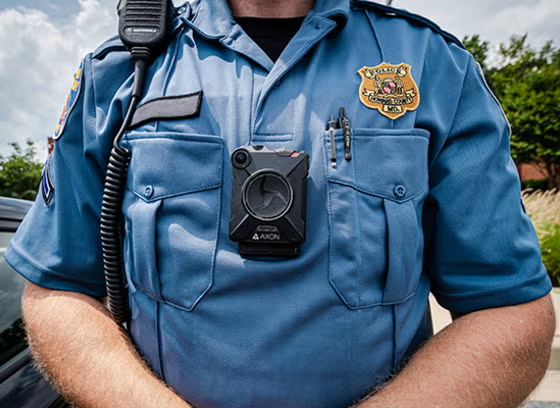
Police officers frequently come across circumstances where the law offers advice but does not control every choice they must make. An officer may have to choose between issuing a warning or citation, making an arrest, looking into the matter further, trying to defuse a tense situation, or directing someone to another service. Police discretion is the term used to describe the power to make these decisions. Because police work in complicated contexts where situations can change fast and strict enforcement of every potential infraction would frequently be impracticable, discretion is a crucial component of modern policing. However, discretion is still debatable because the ability to make personal choices might lead to inconsistent behavior, unfair treatment, and prejudice problems.
Why Discretion Is Important for Police Officers
No departmental regulation or criminal code can predict every scenario that an officer will face. The circumstances of two cases involving the same technical infraction may differ significantly. When considering whether to issue a warning or a ticket for a minor traffic infraction, for instance, an officer may take into account the severity of the behavior, the state of the road, the driver’s actions, public safety concerns, and departmental policy.
Instead of handling every incident in the same way, this flexibility enables officers to take into account the entirety of the issue. In addition to mechanically implementing the law, police officers also uphold public order, deter crime, settle conflicts, safeguard the weak, and handle emergencies.
When alternatives to making an arrest are suitable and allowed by law, authorities may exercise their discretion to do so. An officer may issue a warning, make a referral, issue a citation, help resolve conflicts, or put someone in a crisis in touch with the right resources, depending on the situation and jurisdiction. Officers can better adapt their responses to the conditions and severity of an incident when options are available.
The Debate Over Police Discretion
The same flexibility that necessitates discretion can also raise serious issues. The public may doubt the fairness and consistency of enforcement if two officers react differently to situations that are basically identical. When discretionary decisions seem to differ based on neighborhood, age, race, ethnicity, socioeconomic status, or other factors unrelated to justifiable enforcement goals, the issue becomes especially grave.
Significant racial differences in stop and search choices were discovered in a study spanning almost 100 million traffic stops. Black drivers were less likely to be stopped after sunset, when darkness makes it harder to determine a driver’s race prior to the stop, according to research by Pierson et al. (2020). Additionally, the researchers discovered evidence that Black and Hispanic drivers were subject to lower search levels than white drivers. These results show why discretionary choices should be carefully considered and why gathering data is crucial for spotting trends that could otherwise go unreported.
Instead of considering every discrepancy as the result of a single officer, other research emphasizes the significance of looking at discretion at an organizational level. Using traffic-stop data from North Carolina and Connecticut, Shoub (2022) discovered pervasive racial discrepancies in searches and investigated if lowering specific discretionary procedures could change those trends. Additionally, studies have shown that organizational traits can be linked to enforcement results, showing that police discretion functions within departmental and community contexts rather than in a vacuum (Nowacki & Spencer, 2019).
The difference between traffic stops with higher and reduced discretion has been investigated in more recent studies. Black drivers were more likely than white drivers to be stopped for higher-discretion equipment infractions in the counties examined, according to Camp et al. (2025). Crucially, the researchers discovered evidence that departmental guidelines restricting certain equipment stops could lessen discrepancies. This implies that police departments do not always have to decide between giving officers unrestricted discretion or doing away with it completely. Instead, departments can set more precise guidelines for when and how discretion should be used.
Public trust, procedural justice, and discretion
The public’s perception of legitimacy can also be influenced by how officials use their discretion. People assess police encounters based on whether they believe the procedure was fair as well as whether they get the desired result. In general, procedural justice in law enforcement places a strong emphasis on ideas like treating individuals with respect, being impartial, giving them the chance to speak themselves, and making reliable decisions.
This means that if conditions allow, officers should be able to justify their discretionary actions. Think about two drivers who have identical infractions. Perceptions of unfairness may arise if one person receives a warning while another receives a ticket without a clear and valid explanation for the discrepancy. Therefore, departments can assess whether discretion is being utilized consistently with organizational expectations with the use of documentation, monitoring, and explicit procedures.
Worden and McLean (2018) looked at initiatives to monitor and control procedural justice in interactions between the police and the public. Their study emphasizes the potential significance and challenges of integrating procedural justice into police administration and performance evaluation. The more general lesson is that departments require procedures for assessing police-public interactions and pinpointing areas for improvement; they cannot just declare that officers should use discretion in a fair manner.
Finding the Right Balance
It would be very challenging and would lead to new issues if police discretion were eliminated. Officers frequently come with situations that call for quick decision-making, judgment, prioritization, and interpretation. Officers might not be able to consider reasonable variations across circumstances if the system were totally rigid.
Transparency is crucial. Instead of depending just on individual anecdotes, agencies and scholars can assess trends by gathering data on stops, searches, tickets, arrests, uses of force, and other enforcement decisions. For instance, the Stanford Open Policing Project has gathered and examined millions of traffic-stop data to investigate inequities in law enforcement. While large-scale data cannot explain every single police contact on its own, it might highlight trends that merit more investigation.
In Summary
One of the main conflicts in contemporary law enforcement is police discretion. Officers must be able to respond to complicated situations, discern between varying degrees of seriousness, solve issues, and make decisions that are not realistically predicted by laws or policy manuals. However, this flexibility also makes it possible for uneven results and inconsistent decision-making.
Therefore, whether police officers should have discretion is not the main concern. Policing involves a certain amount of judgment. The more crucial issues include how much discretion officers should have, what limits should apply to it, how decisions should be recorded, and how agencies should assess whether discretion is being used appropriately.
Both responsibility and judgment are necessary for effective policing.
Agencies can maintain the justifiable advantages of discretion while lowering the possibility of arbitrary or biased decision-making by implementing clear policies, effective supervision, excellent training, transparent data collecting, procedural justice, and continuous review. In the end, the debate over police discretion highlights a more significant issue in criminal justice: striking a balance between the consistency, fairness, and accountability required in a democratic society and the flexibility required to properly enforce the law.
References
Camp, N. P., Prabhakaran, V., Hetey, R. C., Monin, B., Jurafsky, D., & Eberhardt, J. L. (2025). Racial disparities in the discretionary context of traffic stops: How organizational practices shape institutional interactions. Journal of Social Issues, 81(3).
Nowacki, J. S., & Spencer, T. (2019). Police discretion, organizational characteristics, and traffic stops: An analysis of racial disparity in Illinois. Policing and Society, 21(1).
Pierson, E., Simoiu, C., Overgoor, J., Corbett-Davies, S., Jenson, D., Shoemaker, A., Ramachandran, V., Barghouty, P., Phillips, C., Shroff, R., & Goel, S. (2020). A large-scale analysis of racial disparities in police stops across the United States. Nature Human Behaviour, 4, 736–745.
Shoub, K. (2022). Comparing systemic and individual sources of racially disparate traffic stop outcomes. Journal of Public Administration Research and Theory, 32(2), 236–251.
Worden, R. E., & McLean, S. J. (2018). Measuring, managing, and enhancing procedural justice in policing: Promise and pitfalls. Criminal Justice Policy Review, 29(2), 149–171.
Photo Credit- Georgetown University. https://evidenceforjustice.georgetown.edu/tech-justice/body-worn-cameras-and-community-perceptions/
Recommended Resources