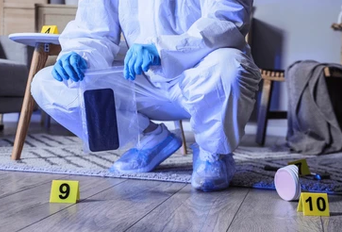
Comprehending Criminal Evidence and Its Significance
As the cornerstone of criminal investigations, prosecutions, and trials, criminal evidence is essential to the administration of justice. Information, testimony, tangible items, records, and digital resources are examples of evidence that can be used to determine whether a crime was committed and who is accountable. Evidence is crucial in the criminal justice system for both identifying suspects and proving guilt as well as shielding innocent people from erroneous convictions. Judges, prosecutors, defense lawyers, law enforcement personnel, and forensic experts all play significant roles in making sure that evidence is appropriately gathered, stored, evaluated, and presented. The validity and admissibility of evidence have a major impact on the criminal justice system’s integrity. Even the strongest suspicions cannot prove guilt beyond a reasonable doubt in the absence of reliable evidence. Therefore, anyone hoping to work in law enforcement, criminal investigations, forensic science, or the legal field must have a solid understanding of criminal evidence.
Criminal Evidence Types and Their Function in Investigations
Criminal evidence comes in a variety of forms, each of which adds important details to an investigation. Fingerprints, guns, blood, DNA, clothes, and other tangible items that could link people to a crime scene are examples of physical evidence. Statements from witnesses, victims, law enforcement, and expert witnesses make up testimonial evidence. Written documents, financial accounts, photos, and official reports are examples of documentary evidence, whereas digital evidence has grown in significance due to the proliferation of smartphones, surveillance systems, social media, and electronic communications.
Additionally, investigators make a distinction between direct and circumstantial evidence. While circumstantial evidence necessitates reasonable inferences to link facts to a conclusion, direct evidence—such as eyewitness testimony detailing an actual event—can prove a fact without the need for an extra inference. Neither is inherently more trustworthy than the other, but both can be compelling. In order to recreate events, establish timelines, identify suspects, and assess alternative explanations, modern criminal investigations often rely on a variety of forms of evidence. Investigators can gain a more thorough and precise understanding of criminal conduct by carefully examining these materials.
Evidence Collection, Chain of Custody, and Constitutional Protections
One of the most significant duties of law enforcement personnel is gathering and preserving criminal evidence. To avoid contaminating, destroying, altering, or misidentifying evidence, investigators must adhere to established protocols. The chain of custody, which records the possession, handling, transfer, and preservation of evidence from its initial acquisition to its presentation in court, is one crucial security measure. Appropriate documentation lessens the possibility that evidence has been tampered with and aids in establishing authenticity. The constitutional safeguards that control the gathering of evidence are equally significant.
The Fifth and Sixth Amendments offer significant protections against self-incrimination and the right to counsel, while the Fourth Amendment shields people from arbitrary searches and seizures. Subject to acknowledged exceptions, evidence gathered through unlawful means may be excluded from criminal proceedings under the exclusionary rule. Additionally, evidence must be assessed by courts in accordance with relevant, trustworthy, authentic, hearsay, and unfair bias principles. These specifications show that criminal investigations must strike a compromise between individual rights and efficient law enforcement. Finding the truth is simply one aspect of the pursuit of justice; another is making sure that the techniques used to gather evidence are legal.
The Future of Criminal Evidence and the Pursuit of Justice
Scientific and technological developments continue to change how criminal evidence is found, examined, and presented in court. Criminal justice experts are now more equipped to investigate complicated crimes thanks to DNA analysis, forensic databases, digital forensics, surveillance technology, and sophisticated investigation techniques. However, these advancements also raise significant issues with algorithmic bias, privacy, cybersecurity, scientific validity, and the possible abuse of new technologies. Because scientific conclusions might be misinterpreted, exaggerated, or impacted by human error, forensic evidence must be analyzed carefully.
Professionals in criminal justice must continue to be dedicated to lifelong learning, moral judgment, and evidence-based investigation techniques. Judges must make sure that the law is obeyed, defense lawyers must assess the government’s case seriously, and prosecutors must reveal significant exculpatory evidence. In the end, criminal evidence serves purposes other than obtaining convictions. Its greatest importance is in assisting the legal system in arriving at just, accurate, and legally sound decisions. In addition to safeguarding both victims and the accused, a criminal justice system that places a high priority on trustworthy evidence, constitutional protections, and professional responsibility enhances public confidence. The dedication to justice, fairness, and truth must continue to be at the core of every criminal investigation as the field develops.
Join us
🌐 Website: https://drgeorgeackerman.com/
📚 Amazon Author Page: amazon.com/author/drgeorgeackerman
📧Email: QAwithProfAckerman@gmail.com
🎙️Podcast: https://drgeorgeackerman.com/podcast/
💼 LinkedIn: https://www.linkedin.com/in/george-ackerman-phd-jd-5946a8290
✍️ Substack: https://substack.com/@drgeorgeackerman
📸 Instagram: https://www.instagram.com/qawithprofackerman/
📘 Facebook: https://www.facebook.com/profile.php?id=61595878768395
📝 Blog: https://drgeorgeackerman.com/blog/
▶️ YouTube: https://www.youtube.com/@QAwithProfAckerman