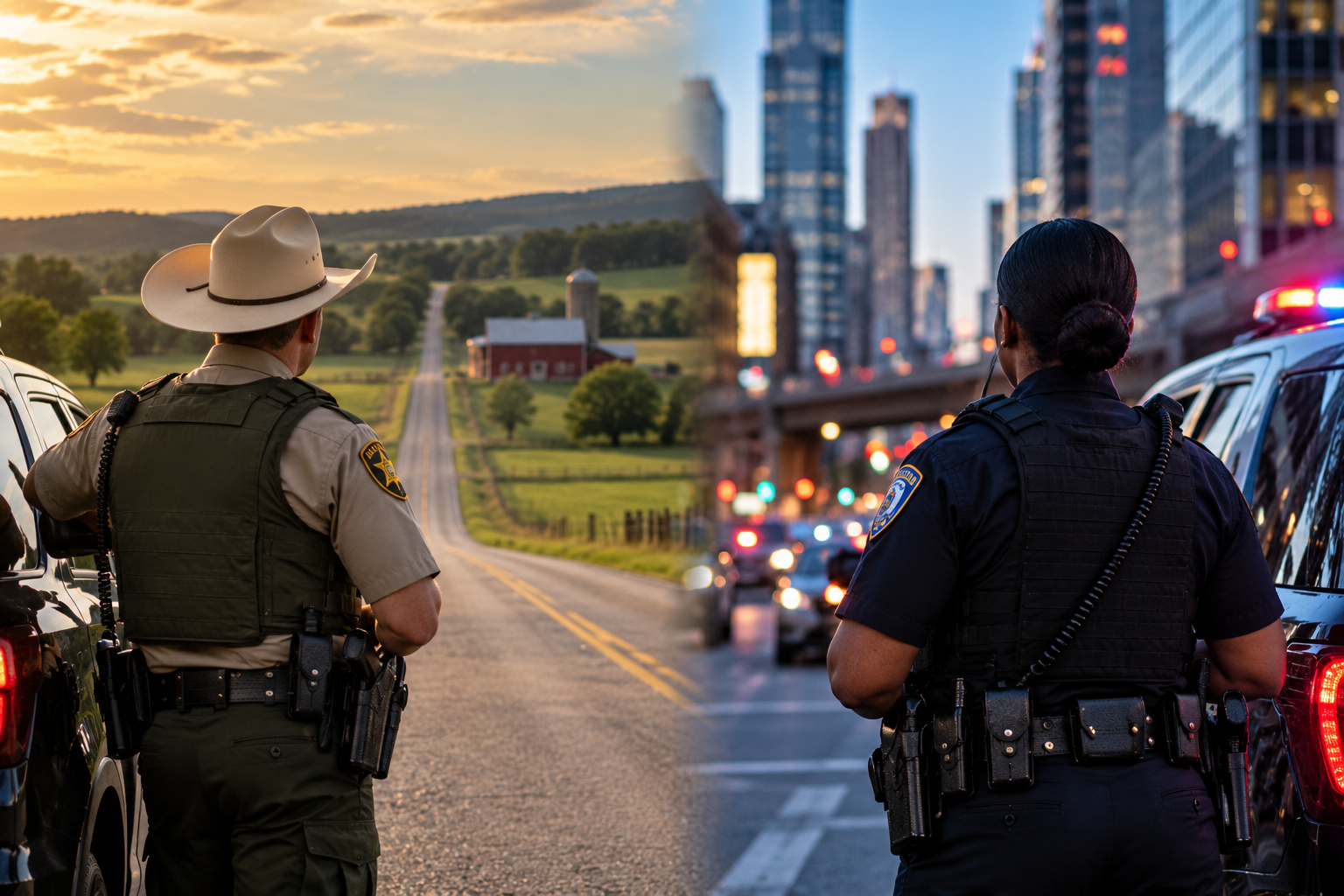
Protecting communities, upholding the law, handling emergencies, and preserving public safety are all shared responsibilities among law enforcement organizations in the United States. However, how these duties are performed can be greatly impacted by the environment in which officers operate. Geographical location, staffing, resources, community ties, and availability to specialized services are some of the ways that rural and urban policing are different. While urban police often serve in more densely populated areas with higher concentrations of service calls, rural officers may patrol wide geographic areas with relatively few officers available for immediate backup. Staffing, recruiting, retention, funding, equipment, and training availability are additional issues that small and rural agencies may encounter (Office of Community Oriented Policing Services & Bureau of Justice Assistance (BJA, 2020). These variations highlight the necessity for policing tactics to be tailored to the unique requirements and traits of the communities they serve.
Resources
Resources and specialization represent yet another important distinction. Specialized units for homicide, drug use, traffic enforcement, tactical operations, crime analysis, cybercrime, community outreach, and other tasks may be found in large urban police agencies. Officers in tiny rural departments could have multiple responsibilities to complete in a single shift. Without having specialized units on hand right away, a rural officer may respond to a traffic crash, look into a burglary, deal with a domestic dispute, help with a mental health crisis, and enforce traffic laws. Additionally, rural agencies may rely more on federal partners, county agencies, state police, or adjacent jurisdictions for specialized support. The operational and resource constraints that rural law enforcement organizations face, such as staffing, technology, equipment, and financial constraints, have been established by research (BJA, 2021).
Factors
Another key factor in differentiating rural and urban policing is community ties. In smaller areas, officers may have personal relationships with a large number of locals, business owners, community leaders, and families. These connections can help cops build trust and learn important information about their communities, but they can also put them in challenging circumstances when they have to uphold the law against a person they know. Close ties between the police and the community are a crucial aspect of law enforcement in smaller areas, according to research on rural policing (Weisheit et al., 1994). Because they serve larger and more diverse populations, urban cops may be less likely to know the people they come into contact with. Therefore, official community-policing initiatives, neighborhood collaborations, outreach programs, and other tactics intended to improve communication and confidence between officers and communities may be extensively relied upon by urban agencies.
Urban vs. Rural
Policing in rural and urban areas shouldn’t be viewed as inherently simpler or more challenging. Rather, every setting poses unique professional problems that call for officers to exhibit professionalism, flexibility, ethical decision-making, communication abilities, and good judgment. While metropolitan officers may work within larger organizations and respond to significant demands related to population density and call volume, rural officers may require more independence and adaptability because support and specialized resources may be farther distant. Understanding these distinctions is crucial for criminal justice students who are thinking about a career in law enforcement. Even though both professionals have the larger goal of safeguarding and serving their communities, working as a deputy in a rural county can differ significantly from working as an officer in a major metropolitan area. Therefore, there is no one-size-fits-all strategy for effective police; instead, agencies and officers must comprehend the populations they serve and modify their methods accordingly.
References
Office of Community Oriented Policing Services, & Bureau of Justice Assistance. (2020). Conversations with rural law enforcement leaders: Volume 1. U.S. Department of Justice.
Office of Community Oriented Policing Services, & Bureau of Justice Assistance. (2021). Conversations with rural law enforcement leaders: Volume 2. U.S. Department of Justice.
Weisheit, R. A., Falcone, D. N., & Wells, L. E. (1994). Rural crime and rural policing. National Institute of Justice, U.S. Department of Justice.
Weisheit, R. A., Wells, L. E., & Falcone, D. N. (1994). Community policing in small town and rural America. Crime & Delinquency, 40(4), 549–567.
Recommended Resources