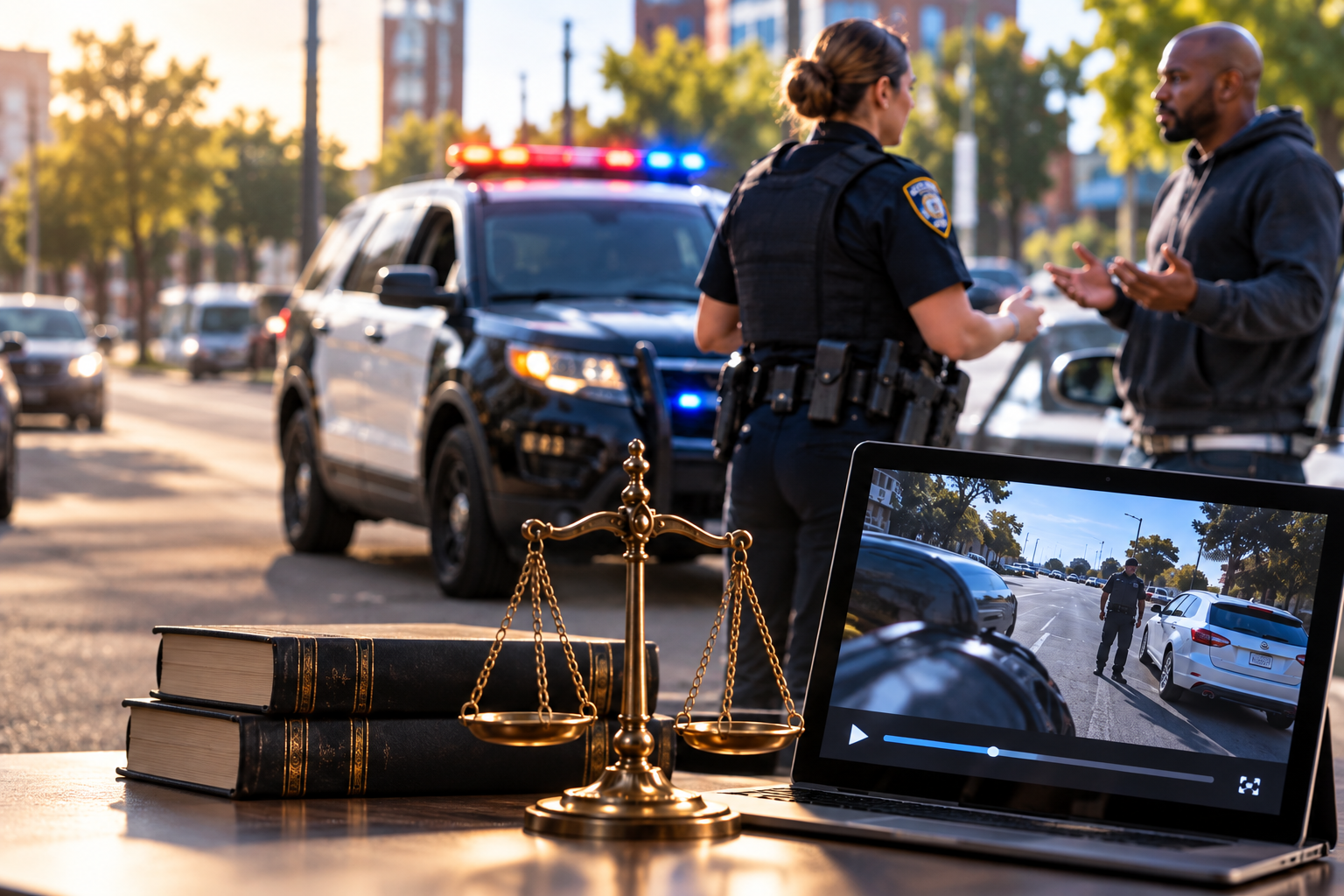
Body-Worn Cameras in Policing
Body-worn cameras, or BWCs, are becoming a significant component of contemporary law enforcement and the ongoing debate about police accountability and openness. These tiny recording devices, which can record encounters between police officers and members of the public, are usually placed on an officer’s uniform. One of the main justifications for body-worn cameras is that, in situations when concerns are raised regarding the behavior of a civilian or an officer, video can offer an extra piece of evidence.
Body Camera Records
Investigators, supervisors, prosecutors, defense lawyers, and courts may have access to recorded evidence instead of depending just on conflicting memories of an incident. However, it’s crucial to consider recordings in the larger context of an incident because body-camera footage does not always capture all an officer sees, hears, or experiences (National Institute of Justice [NIJ, 2022). By producing a record that can be examined after complaints, use-of-force events, arrests, traffic stops, and other police encounters, body-worn cameras can help promote accountability. Supervisors may use recordings to assess whether officers adhered to departmental policies and to pinpoint areas that require further training. Additionally, when allegations against cops conflict with recorded events, cameras might offer proof to defend the officers.
The Research Shows…
Research on BWCs has yielded conflicting results about how they affect outcomes like citizen complaints and the use of force, indicating that merely installing cameras does not always result in increased accountability (Lum et al., 2020). The usefulness of the equipment can be greatly impacted by how agencies use it, including activation requirements, supervisory review, training, and camera policy enforcement.
However, there are significant ethical, legal, and privacy issues with body-worn cameras. Officers regularly visit homes, hospitals, schools, and other places where individuals can be going through some of their most trying times. Children, witnesses, victims of crime, and anyone going through medical or behavioral problems may all be documented. Therefore, agencies must strike a balance between privacy and transparency and carefully set policies regarding when cameras must be turned on, when recording can be stopped, who can view footage, how long recordings are kept, and when video should be made public. Instead of seeing cameras as just another piece of police gear, the Bureau of Justice Assistance (n.d.) has stressed that effective body-worn camera programs require agencies to take into account policy formulation, training, privacy, data management, and community participation.
Accountability
Body-worn cameras should be viewed as a tool for accountability rather than a comprehensive fix for issues with police behavior. Ethical leadership, efficient oversight, suitable training, unambiguous policies, impartial investigations, and a robust corporate culture cannot be replaced by technology. However, when used properly, BWCs may support training, offer useful evidence, help with complaint investigations, and promote increased transparency. Therefore, the bigger concern for law enforcement organizations is not only whether or not officers should wear cameras, but rather whether departments have created organizational procedures and regulations that guaranty the technology is applied consistently, morally, and successfully. A camera can record an incident, but what an agency does with the data it captures is ultimately what determines effective police accountability.
References
Bureau of Justice Assistance. (n.d.). Body-worn camera toolkit. U.S. Department of Justice.
Lum, C., Stoltz, M., Koper, C. S., & Scherer, J. A. (2020). Research on body-worn cameras: What we know, what we need to know. Criminology & Public Policy, 19(1), 93–118. https://doi.org/10.1111/1745-9133.12412
National Institute of Justice. (2022). Body-worn cameras: What the evidence tells us. U.S. Department of Justice.
Recommended Resources